MI London vs Sunrisers Leeds — Match 1 Fantasy Picks, With a Conditional Reading
A pre-toss fantasy read for the Hundred 2026 opener at Kennington Oval, written as a set of named conditions you can flip the moment the coin lands or the team-sheet changes.
The match, in one paragraph
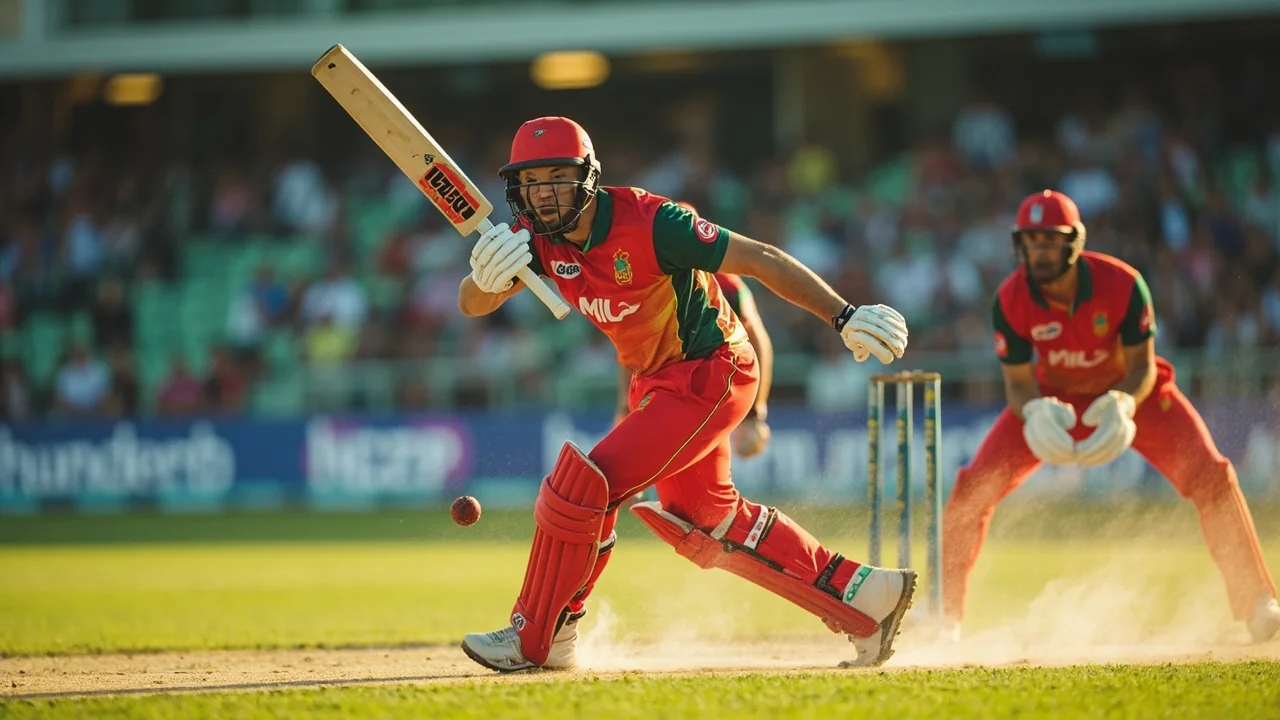
The Hundred 2026 opens at Kennington Oval on 21 July 2026 with a 11:00 PM IST start for Indian viewers, broadcast on Sony Sports Network and streamed on FanCode. MI London — the rebranded Oval Invincibles, led by Sam Curran — begin as three-time defending champions with Nicholas Pooran, Jason Roy, Will Jacks, Trent Boult and Richard Gleeson in the mix. Sunrisers Leeds — the rebranded Northern Superchargers, led by Zak Crawley — open a new chapter with Mitchell Marsh, Dan Lawrence, Ryan Rickelton, Brydon Carse and Nathan Ellis. A tournament opener is rarely a stable fixture: it is the easiest match of the year to over-pick and the hardest one to defend after lock. So this page is built as a conditional reading rather than a verdict.
Reading two squads through roles
Names win press conferences. Roles win fantasy points. Separate who plays from how they will be used.
The Hundred is a 100-ball format with five-ball blocks, no overs in the conventional sense, and a 15-second fielding clock. That is the structural reason squad lists mislead fantasy users: a star batter who batted at four in T20 cricket may be asked to open in the Hundred, and a frontline pacer may only get two of the twenty-five legal balls. Treat the playing-XI desk as a starting list, not a finished answer.
For MI London, the announced core reads as Pooran, Ollie Pope, Jason Roy, James Vince, Sherfane Rutherford, Sam Curran, Tom Curran, Trent Boult, Richard Gleeson, Rashid Khan and Olly Stone, with Will Jacks, Ollie Sykes, Callum Parkinson and Nathan Sowter on the bench. The role map that matters: a left-handed top-order accelerator in Roy, a middle-overs anchor in Vince, a finisher-plus-wicketkeeper in Pooran, a five-ball powerplay-and-death operator in Rashid, and a new-ball swing pair in Boult and Gleeson.
For Sunrisers Leeds, the announced core reads as Tom Alsop, Ryan Rickelton, Zak Crawley, Harry Brook, Brydon Carse, Dan Lawrence, Benny Howell, Mitchell Marsh, Nathan Ellis, Abrar Ahmed and Matthew Potts, with Thomas Lawes, Ed Barnard, Liam Patterson-White and Reece Topley on the bench. The role map here is a top-order rebuild around Crawley and Brook, an all-round seam-bat cluster in Carse, Howell and Marsh, and a spin option in Abrar Ahmed that gives the side a different shape to MI London.
Role map at a glance
Kennington Oval pitch and London weather
Translate surface and sky into role adjustments before you look at names.
The Kennington Oval surface in July usually behaves like a true English deck: good pace and bounce through the first 25 balls, lateral carry to the keeper, and a surface that flattens slightly as the innings progresses once the white ball loses shine. Fast bowlers tend to get the ball to move off the seam early; spinners who can flight and change pace tend to cash in during the middle block.
The published forecast for the window shows cloudy skies, a temperature around 16.7°C and humidity at 78 percent. Cloud and humidity are not aesthetic details. They extend the period during which the ball does something in the air, which matters more in a 100-ball game than in a 120-ball T20 because there is no time for the surface to reset.
Three practical adjustments follow. First, premium new-ball bowlers gain a small edge over death-only specialists in this weather. Second, top-order batters who handle late movement have a higher floor than anchor batters who need a flat track. Third, a wicketkeeper-batter who keeps in seam-friendly conditions has a steadier dual-role ceiling than one kept in for batting alone.
Conditional picks for the opener
Each pick carries a single named condition. If the condition breaks, the pick expires.
Powerplay batter — Jason Roy (MIL)
Condition: confirmed in the top three and MI London batting first.
Roy’s Hundred record at the Oval is built on early movement against the new ball. If he is sent in at three and his side bats first, he is a high-floor powerplay pick. If he slides down or his side chases, downgrade.
Anchor — James Vince (MIL)
Condition: confirmed in the top four.
Vince is a middle-overs stabiliser in a side that already has finishers below him. He offers a steadier ceiling than a pure accumulator when the surface still has lateral carry.
Wicketkeeper-batter — Ryan Rickelton (SRL)
Condition: confirmed opener and keeping the gloves.
Rickelton is the rare keeper who offers dual credit in a format where keeper points are weighted. If he opens and keeps, he is a multi-purpose pick. If he is rested from gloves, narrow his role.
Middle-order accelerator — Harry Brook (SRL)
Condition: confirmed in the top six.
Brook is the highest-impact batter on the Sunrisers Leeds list on a flat surface. On a seaming Oval, his floor drops, so treat him as an upside pick, not a base pick.
All-rounder — Mitchell Marsh (SRL)
Condition: confirmed as a seam-bowling all-rounder.
If Marsh bowls his full allocation, he becomes a two-skill pick in a five-ball format. If he is used only as a batter, narrow him to a batting-only credit.
Wrist-spinner — Rashid Khan (MIL)
Condition: confirmed in the XI and bowling his full allocation.
Rashid is the cleanest captaincy-and-vice-captaincy option when the spinner is allowed to bowl across phases. The condition here is usage, not selection.
New-ball seamer — Trent Boult (MIL)
Condition: confirmed opening the bowling.
Boult’s left-arm angle in cloudy London is the kind of matchup edge the Hundred rewards early. If he is held back for death, downgrade.
Death seamer — Nathan Ellis (SRL)
Condition: confirmed bowling at the back end.
Ellis is a yorker-and-slower-ball operator whose ceiling jumps if he is used at the back end of an innings rather than in the powerplay.
Spinner in form — Abrar Ahmed (SRL)
Condition: dry phases in the middle block.
Abrar is the difference in shape between the two sides. On a gripping Oval, he outranks a fourth-seamer option.
Captain and vice-captain framework
Captaincy is the highest-leverage decision of the match. Treat it as a portfolio, not a guess.
For an opener, the safest vice-captaincy framework is to split risk between a high-floor batter in the top three and a high-impact wrist-spinner with phase flexibility. The Hundred scoring rewards both roles because boundary frequency and wicket points compound in a five-ball block.
If MI London bat first, the base case is to back a top-order MI batter as captain and an MI wrist-spinner as vice-captain, on the assumption that the chasing side will face a slightly older ball and a more middle-overs-bound game. If Sunrisers Leeds bat first, invert the base case and back a top-order SRL batter with a Marsh or Carse credit behind. If the side batting first is restricted under 130, switch the captaincy to a death bowler.
For a deeper read on multiplier selection across formats, the captain and vice-captain desk applies the same logic to IPL fixtures. The principle is the same: captaincy should track scenario range, not recent form.
Three scenario plates
Lock-window plan, toss to deadline
A short timeline keeps fantasy decisions honest when news breaks late.
The match is scheduled to start at 11:00 PM IST on 21 July 2026. Most fantasy platforms lock lineups 5 to 15 minutes before the first ball. Working backwards from lock, the fantasy window is not the whole day; it is a short, high-information window after the toss.
Use this sequence. One hour before lock, freeze the squad list and identify the players whose role is unchanged by the toss. Thirty minutes before lock, when the toss lands, swap the batters whose role depends on batting order and the bowlers whose role depends on phase allocation. Ten minutes before lock, apply one last check for late injury news and adjust only the affected slot.
The plan protects against the most common fantasy failure on opening nights: a side that announced a player in the squad but rested him from the XI, or a side that batted first when the fantasy platform had weighted a chase. Treat today’s cricket match picks as the live update surface, not this opener-specific page, once the toss lands.
What changes the picture
Name the failure modes in advance so you can spot them at lock.
Toss surprise
A captain chasing at the Oval in July dew conditions flips the role map. The chase side gets a slightly older ball and a flatter second-innings surface.
Late injury
A XI change published after this page was written voids the role assumption. Re-check the playing-XI desk before lock.
Role downshift
A bowler named in the XI but held back for two of the five-ball sets removes his fantasy value even when he plays.
Pitch drift
A greener-than-expected Oval pitch narrows the batting shortlist and lifts the premium-seamer shortlist.
Dew window
Late-evening dew in London can grip under lights. If the side batting second sees visible dew, downgrade second-innings spinners.
Format curve
The Hundred’s opening night often produces one over-performing unit and one over-priced one. Avoid paying a premium for the previous season’s stat line without a current-role check.
Quick answers before lock
Short answers that pair with the conditional picks above.
Is MI London the right favourite?
The Hundred record points to MI London as three-time defending champions under their old name. A tournament opener is not a final, and the rebranded Sunrisers Leeds have a squad built to challenge, not to survive.
Who is the safest vice-captain pick?
For a base case, a top-order batter from the side batting first, paired with a wrist-spinner who bowls across phases. Switch the wrist-spinner to a death bowler if the first innings finishes under 130.
Where do overs matter most?
The Hundred replaces six-ball overs with five-ball sets. Phase allocation is the difference between a premium all-rounder and a name on a squad sheet.
Should I trust the pre-toss XI?
Treat the announced XI as probable until both toss and playing card are confirmed. Re-check the playing-XI desk ten minutes before lock.
What changes if it rains?
A shortened Hundred reduces the value of anchor batters and death bowlers. In a five-set match, top-order aggressors and a single wrist-spinner carry the slate.
Does this page guarantee an outcome?
No. This is a conditional read. The picks expire the moment the named condition breaks. For ongoing updates, use the match-prediction desk.
Limits of a pre-toss fantasy page
Pick within a budget you can afford to lose. Expire a pick when its condition breaks.
An opener is the easiest match of a tournament to over-pick. Two safeguards help. First, build a budget that is small enough to repeat across the season rather than one that has to win the first match. Second, decide in advance which named condition, if it breaks, will force a full lineup rethink, and stick to it.
This page does not promote paid contests and treats fantasy as an editorial research exercise. The picks above are conditional reads, not promises. For a wider set of frameworks, the responsible-play desk outlines time, spend and stop limits before the season begins.
Three expiry rules
Build a lineup that survives the toss
Pair this conditional read with the playing-XI desk, the captain framework and the live match desk before lock.